
Healthcare is one of the most complicated industries in the country. It’s a business on the one hand, but also a social service and a key component of community infrastructure on the other.
When a hospital is short-staffed, it’s not a matter of inconvenience. Lives get lost, people go without treatment, and problems perpetuate in terms of long-term healthcare viability. In other words, the longer that a hospital system goes without adequate staffing, the worse the problem will become.
And that’s just one of many complicated factors that a hospital system must balance in order to be effective. Fortunately, digital technology gets better every year, making many of the logistical complications of healthcare more manageable.
In this article, we take a look at how digital technology has solved and continues to solve some of the most complex issues facing modern healthcare—including the training of new professionals.
Digitalization of Healthcare Records
Electronic health records are not exactly new, but they have provided significant improvements in communication and information sharing within the healthcare context. Thanks to digital healthcare records, it’s easy for hospital systems to rapidly exchange information or share it with specialists within an existing system.
It’s also been an enormously empowering resource for patients, who can now manually review their health data points anytime they need to, for better or for worse. Many a modern doctor has been forced to answer very obscure questions about blood panels that were not really relevant to begin with.
Ultimately, though, it’s a positive thing. More information equals more power for providers and patients alike.
While digital health records have not precisely improved the way healthcare education is executed, they have contributed positively to new generations of highly empowered professionals.
Doctors and nurses in training today are being brought up in a faster-paced educational environment than ever before.
Telehealth
Telehealth technology makes it easy for patients to have simple questions answered remotely by doctors or nurse practitioners. Though it’s not applicable for everything, it’s a good way for healthcare systems to reduce the number of unnecessary in-person visits, thus raising their overall capacity for higher-touch scenarios.
Telehealth is also an effective tool in rural healthcare environments, where it is often difficult for patients to consistently get to the hospital.
In the context of professional training, telehealth has also significantly expanded shadowing and mentorship opportunities. It is now easier than ever for nurses in training to connect with professionals all over the world.
Not only does this resource diversify student exposure to more professionals, but it also introduces them to a genuinely valuable new skill that they may leverage for future employment opportunities.
Big Data
To adequately explain the way that data is being used in the healthcare setting, we’d need a lot more space than just this one heading. That said, there are lots of ways that it is increasing efficiency and overall patient outcomes.
- Staffing. Though the staffing situation in the world of healthcare is far from perfect, big data makes it so that hospitals can refine their searching to identify candidates most likely to stick around. It also helps monitor employee satisfaction with the aim of improving retention.
- Wearable healthcare technology. Wearables like glucose monitors, heart monitors, fitness trackers, blood oxygen monitors, and so on provide doctors with enormous amounts of information that make it easier to evaluate patient health.
- Census information. With generalized population-related data, hospitals can also identify local health trends. For example, high rates of obesity, vaccine hesitancy, respiratory illness that might relate to an environmental factor, and so on.
With lots of information and an increasingly reliable way to process it quickly through AI integrations, healthcare systems are more responsive than ever before.
While big data is being introduced to every facet of healthcare, it’s today’s students who have the most up-to-date understanding of it. Modern nursing and medical schools are not only incorporating wearables and census data sets into training.
They are also integrating automation, training future healthcare providers to be better equipped than ever before to handle large sets of information.
A More Robust Clinical Environment
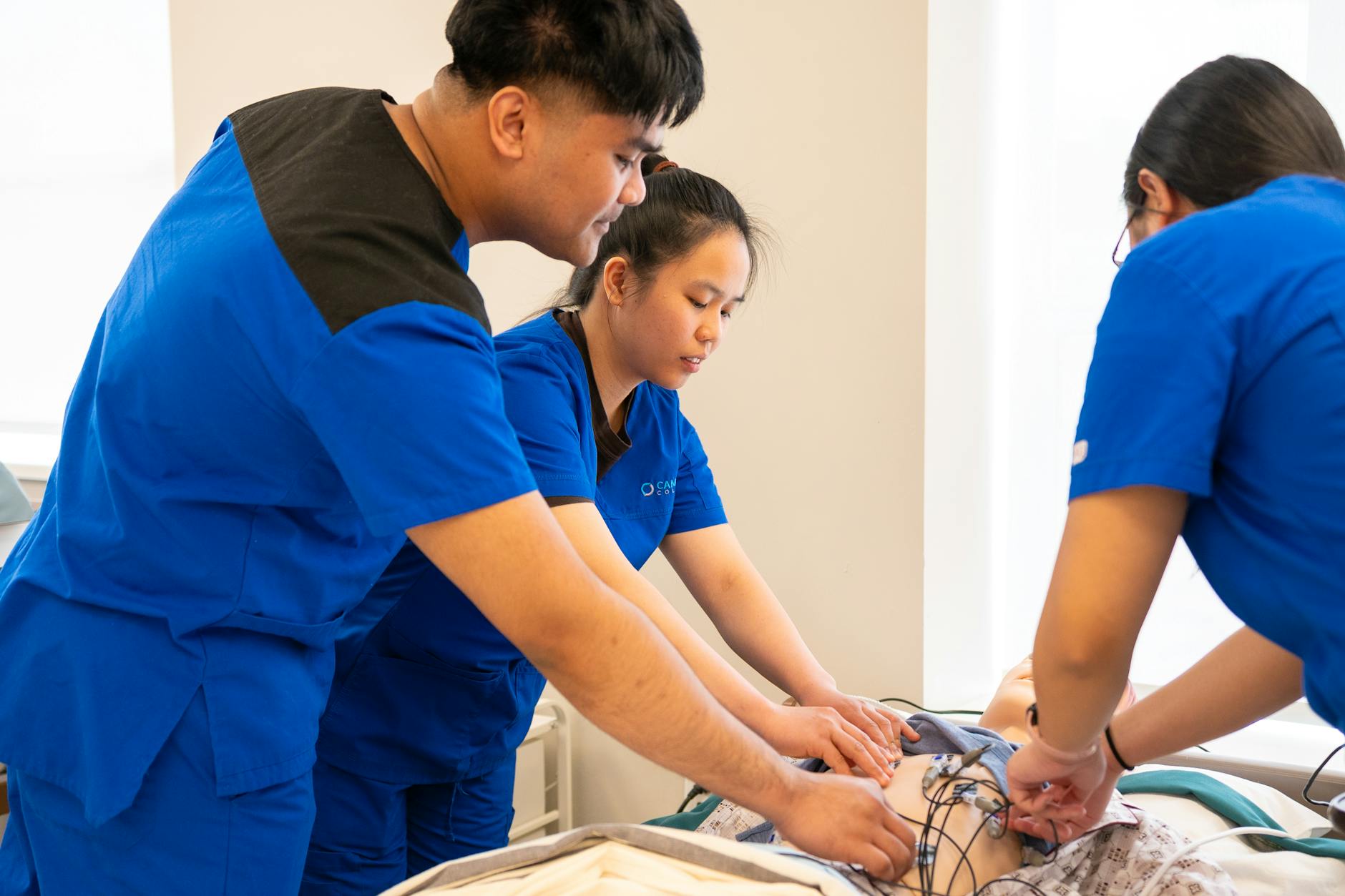
Simulation labs, as well as virtual reality scenarios, have allowed nursing students, as well as doctors in training, to gain experience in even relatively obscure healthcare situations.
Clinical rotations have long been an important part of healthcare education and training, but regardless of how comprehensive they are, they’ll never prepare a doctor or nurse for every eventuality. There are simply too many things that can happen in a hospital for that.
With digital preparation tools paired with hands-on experience, doctors and nurses are more prepared than ever.
Conclusion
Technology without great people behind it doesn’t get you very far, particularly not in healthcare.
The benefits of being a nurse are many: good compensation, flexible scheduling, and work that genuinely fulfills you.
Technology that makes the work a little easier is an enhancement, but not a replacement for good, caring people who are ready to give the job everything that they have. Technology changes all the time. What will never go away is the fact that the world needs good doctors and nurses.

 EDTECH 4 BEGINNERS